When the poem I have been working on suddenly revealed itself to be in form, my resulting rearrangements to satisfy the form included the trimming of certain lines where the poem was too verbose, as well as the panicking over stanzas that were missing requisite lines. I marked where more words and images were needed, and set the poem aside.
Later, when I came back to the poem and stared at the gaps, I suddenly remembered how certain words I had heard or read in the past few days seemed to speak to me, to demand my attention, to the point that I had jotted these words down in a notebook. I got out that notebook and saw the word "pinwheel". A good word, but it had nothing to do with my perforated poem. But wait--yes, it did. And suddenly my poem had a pinwheel in it. Creation myth was on the list, and soon that went in the poem as well, despite seeming at first glance to be not even tangentially related.
A few more list words worked their way into the poem, and the gaps were closed up, the poem finished.
At first I thought how weird it was that the words I had been culling from the universe earlier were just the words I needed now; it made me recall an image I had earlier this year, that inspiration is floating in the air all around us and we just have to pay enough attention to find it and pluck it out of the air. I don't really believe that inspiration exists a priori, despite that vision, and yet, here were the words I would need for my poem written in a notebook before they were needed, while tens of thousands of other words read and heard during the same time period had easily vanished from my mind.
But that's just the beauty of the unconscious. Either (in an unlikely scenario) my unconscious knew the very words I would need later because I had already begun the at-that-time-unstructured poem when I started the word list, or (more likely) my unconscious was merely identifying words that had deep resonance with me, words such that my interest in them would enable me to connect to them to whatever I was thinking about, because of the way the mind seeks connections, looks for patterns.
Whatever the reason, here's my take-away: words that catch my attention, words that make me say, "huh...." or "I haven't heard that word in awhile," in short words whose word-ness or very essence make me stop in my tracks for just a moment, those words should be written down; they will probably be useful to me very soon.
Monday, October 21, 2013

Sunday, October 20, 2013
Concrete Wolf 2013
Concrete Wolf (Lana Hechtman Ayers, editor and publisher) is holding its annual chapbook competition. This is the press that published my chapbook, so it is near and dear to me. If you've got a manuscript ready to go out, please consider sending it here. This year's judge is Carol Levin. The entry fee is $20; the deadline is November 30th; pages should be between 16 and 26. Good luck!
Saturday, October 19, 2013
Surprise! Surprise! Surprise!
Not too long ago I read the advice of a major poet (but I did not write down this advice, so I cannot attribute this) that each line of a poem should contain at a minimum three surprises. Three surprises--this seemed excessive and unattainable and so I did not write down the advice and expected to forget it.
But I haven't. And I'm glad I haven't, as this idea has improved my recent poems more than anything has in a long time. And I don't know who to thank for it; if you know, please tell me (I tend to think its one of the Charleses (Wright, Olson, Simic....not Bukowski or Baudelaire), but then again, maybe not).
I'm not sure what the mysteriously unknown major poet counts as surprises, but I have counted: especially effective line breaks, unexpected word choices, fresh images, imaginative use of punctuation, alliteration or assonance or other repetitions of sounds, internal rhyme, manipulations of the usual grammar, non-intuitive pairings of words, the occasional insight, unusual subject matter, anything that makes me think or read twice.
I also only aim for two surprises per line, as I am just a beginner at this. But lines that have no surprises in them suddenly jump out at me and demand their fair share. And it may be the highlighting of the weak line, the disallow of a single weak line, that is the biggest benefit to me of this technique: the idea that it's not enough for a line to be carrying the reader toward the next, better line.
When I read a poem, it is the sense of wonder and surprise that pleases me most, so it seems only obvious that that is what I should be writing towards. But it wasn't obvious to me. Until now. Surprise yourself, and the reader will likely also be surprised.
(Also, I like checklists; give me something to measure or count and I am all in. This technique really works for me!)
Friday, October 18, 2013
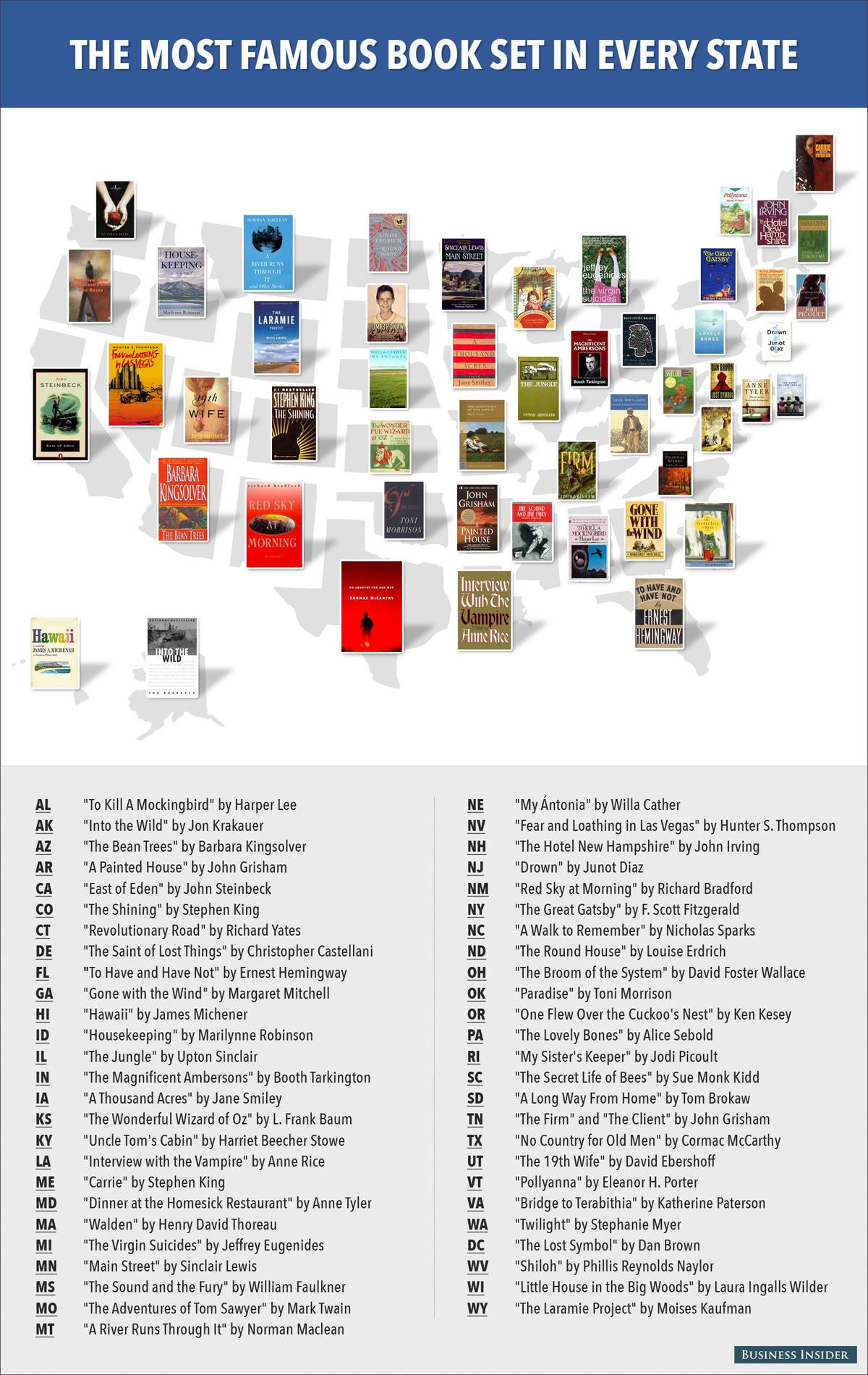
Most Famous Book Set in Every State
Alice Sebold's The Lovely Bones (Pennsylvania). Steinbeck's East of Eden (you know where!). Hemingway's To Have and Have Not (again, you know where!). These are the most famous books set in states that have been formative places for me. Check out the states that most matter to you:

Monday, October 14, 2013
Tripping the Light Ekphrastic
A few months ago I wrote about Black Tongue, a journal that pairs artists and poets in a collaboration of ekphrasis.
I've now run across another journal with a similar mission of pairing poets and artists to respond to one another's work. This one is called The Light Ekphrastic.
I may find more of these interesting projects, and if I do, I'll post about them.
I've now run across another journal with a similar mission of pairing poets and artists to respond to one another's work. This one is called The Light Ekphrastic.
I may find more of these interesting projects, and if I do, I'll post about them.
Subscribe to:
Posts (Atom)