Sleep-wise, I've had an abysmal week. I suffer from a kind of insomnia known as early morning wakefulness, which means that I have no trouble getting to sleep, but staying asleep is a real problem. For the past six months or more, I've been waking up in the mornings at 4:00 or 4:30, unable to return to sleep (this is a cycle I've had periodically for more than 20 years).
However, this week my wake-up time has inched its way into the unreasonable zone. First I was waking up at 3:30, and then 3:00, then 2:30, and the night before last I was up at 1:30, just 2 1/2 hours after I'd gone to bed. Up and awake and alert, with no chance of going back to sleep.
Today I listened to a podcast on sleep disorders, hosted by the New York Academy of Sciences' podcast Science & the City. The opening segment was with journalist David Randall, author of Dreamland: Adventures in the Strange Science of Sleep, who was inspired to delve into this topic because of his own sleepwalking issues. Randall discussed how the invention of the lightbulb has divorced modern sleep patterns from the cycle of the sun, by which our brains and sleep cycle are naturally regulated, as shown by experiments in which subjects are sequestered in an environment lighted to copy the sun's cycle. In those cases, sujects fall asleep just after sundown and wake up around daybreak.
However, there's one more behavior these subjects exhibit that I didn't anticipate. They tend to wake up around midnight or one in the morning, and stay awake for about an hour before returning to bed. (The natural phenomenon of this "first and second sleep" are documented in the Canterbury Tales and in 16th century French physicians' manuals.) During this awake time, subjects reported feeling quite good and indulging in "me" time. Researcher who drew their blood found the subjects' exhibited heightened levels of pro-lactin, a hormone which is linked to a feeling of contentment.
This was news to me...instead of feeling robbed of my sleep and desperate to return to it, I will now try to think of my middle-of-the-night awake time as an indulgence of free time for myself, a biologically-programmed way for me to get the downtime I am definitely not getting during the day (and perhaps that is why my body/mind keeps waking me in the night, for forced downtime?).
Coincidentally, today I also read an article on the Writer's Digest website, entitled "Do You Dream In Paragraphs? Mine Your Dreams For Writing Ideas," about ways to get creative ideas from your dreams. I've written about this in the past on this blog, so I won't cover that territory today, but if you are interested, check out the article at Writer's Digest. As for me, I haven't fixed any poetry dilemmas in my wakefulness this past week, but I was able to solve a problem I've been having with an analytical task for my linguistics course. That liminal time between awake and asleep (which I've doubled with my first and second sleeps now!) is a boon to the mind's flexibility--I'll remember that too when I undoubtedly wake in the middle of the night tonight!
Showing posts with label New York Academy of Sciences. Show all posts
Showing posts with label New York Academy of Sciences. Show all posts
Friday, April 26, 2013

Thursday, April 25, 2013
In Praise of Broadmann Area 47 (and Galoshes)
I've been listening to a podcast about the science of sound, as explained for the lay audience, by scientist Daniel Levitin and musician Rosanne Cash, hosted by the Science & the City (the podcast of New York Academy of Sciences). At one point, Levitin is describing the part of the brain that is responsible for organizing sound, called Broadmann Area 47 (the red-highlighed area below), and Cash laughs and says with irony, "What a poetic name," or something akin to that.
Which I take exception to. Why is the name "Broadmann Area 47" not considered poetic? Because it has a technical sound to it, a scientific sound? Because it's so specific? Because it has a number in it? To all these ideas, I take exception. To me, nothing is more poetic than a very specific reference that works as an image. I LOVE the name Broadmann Area 47. I would use it in a poem; in fact, now it will be a mission of mine to do so. (Not that this is necessarily a meaningful mission--I recall once reading a poem before which the poet explained that having been told there could be no poem about galoshes, she had written one; I just googled 'galoshes poem' to try and find it for this post, and couldn't, but I did discover that there are an abundance of poems about galoshes now.)
There are no poetic words, and no non-poetic words. It's the way, the manner, and in the context in which words are used that render them poetic. The ugliest-meaning word can be poetic when used to effect. The ugliest-sounding word also has its place, due in part to the reaction created by the harsh sounds. The words with the most banal meanings can be exquisite when used outside of a banal context. Broadmann Area 47 just by itself sounds lovely to me (put a number on anything and you've got my attention) but it could be made meaningful and poetic to a general audience when used by a good poet.
Which is to say that words need be neither mellifluous nor with unequivocally positive associations to be in a poem, but they need to be evocative.
These days traditionally "poetic" words--light and dark and longing and absence (all of which are topics of mine)--are banal themselves, rendered unpoetic through overuse. Fresh language and new imagery, that's where the poetry is--right there in Broadmann Area 47, which is not only responsible for organizing sound, but also for the processing of syntax in language. So ironically, if you want poetry, Broadmann Area 47 is not only among the right words to use, it's one of the places in your brain that you'll be using them. Bring your galoshes.
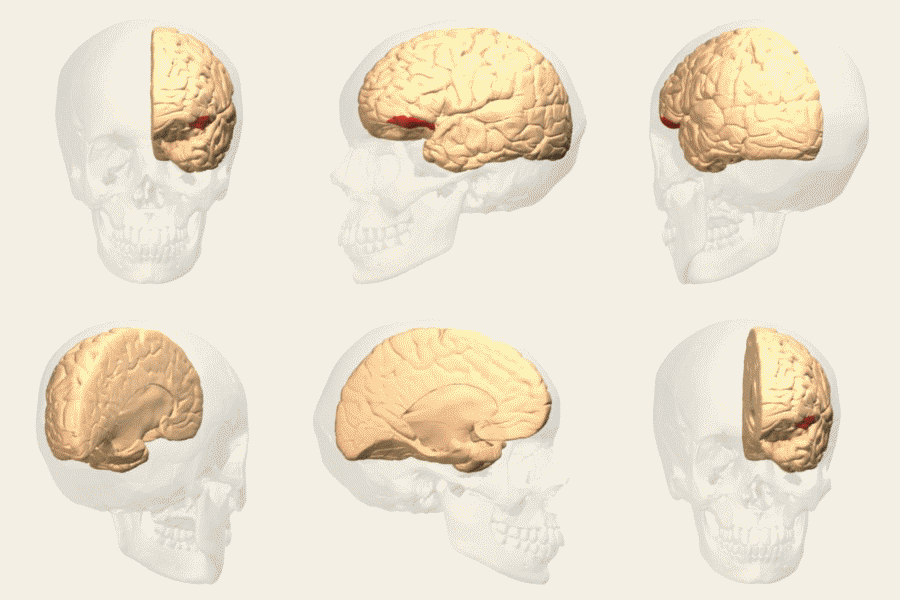 |
| from BodyParts3D, copyrighted by The Database Center for Life Science licensed under CC Attribution Share-Alike 2.1 Japan |
There are no poetic words, and no non-poetic words. It's the way, the manner, and in the context in which words are used that render them poetic. The ugliest-meaning word can be poetic when used to effect. The ugliest-sounding word also has its place, due in part to the reaction created by the harsh sounds. The words with the most banal meanings can be exquisite when used outside of a banal context. Broadmann Area 47 just by itself sounds lovely to me (put a number on anything and you've got my attention) but it could be made meaningful and poetic to a general audience when used by a good poet.
Which is to say that words need be neither mellifluous nor with unequivocally positive associations to be in a poem, but they need to be evocative.
These days traditionally "poetic" words--light and dark and longing and absence (all of which are topics of mine)--are banal themselves, rendered unpoetic through overuse. Fresh language and new imagery, that's where the poetry is--right there in Broadmann Area 47, which is not only responsible for organizing sound, but also for the processing of syntax in language. So ironically, if you want poetry, Broadmann Area 47 is not only among the right words to use, it's one of the places in your brain that you'll be using them. Bring your galoshes.
Subscribe to:
Posts (Atom)