Our neighborhood celebrated Halloween last night (the 30th of October here in Japan) even though it was raining. Although Halloween parties and treats are becoming gradually more known here, a trick-or-treating venue is still relatively hard to come by. However, since we moved in to our current neighborhood about 6 years ago, our neighbors have embraced trick-or-treating; well, some of them have. In order not to disturb the ones who haven't, we distribute a flyer featuring a jack-o-lantern to the neighbors who want to participate, and kids are told to only ring the doorbells of homes with the right picture on the door. It works. Fun was had last night by all who participated. And the others tolerated the noisy running around the street quite nicely.
Speaking of noise, later this week a relative is coming to stay with us. This relative is older and doesn't adjust very well to the idea of family-style living, so her visits are always a challenge. In particular, her need to have the television running 18 hours a day at top volume is a real problem for me (and for my children who have a hard time studying during her visits, or having friends in to play, or doing anything). I cannot work well when she visits, cannot write, and feel distressed a good portion of the time. We don't have a very big home (it's big for Japan but still not big enough that we have more than one tv, or that what one person does at full volume in one part of our home doesn't affect everyone no matter if in the same room or not). So we have announced that from this visit forward, she will have to limit her television-watching to when the children are not studying or entertaining friends (which won't salvage my days, but part of hosting a guest is putting up with crap, I suppose). This particular relative has never taken suggestions well, so we will have to see how she takes outright rules. Shall keep you posted.
Anyway, this got me thinking about silence and how I crave it. When my husband leaves for work and the kids for school, I turn off the tv (which had been on for the morning news) and I don't turn it or a radio or any music on until the family returns and turns that kind of stuff on for themselves. I do work for my clients in silence, I write in silence, I do housework in silence, and that's the way I like it. When I leave the house I put on my iPod and listen to podcasts rather than have to listen to whatever noise the city streets would impose on me. Silence is absolutely key to my sense of well-being. It's odd, considering I grew up as one of eight kids in a house constantly full of noise, or perhaps it's not odd, considering that.
Anyway, this week Tupelo Press editor Jeffrey Levine featured a post about sound on his blog, which is right in line with what I'm musing about these days. He quotes the line from poet Olena Kalytiak Davis's prize-winning book And Her Soul Out of Nothing, "the brain sits right next to the ears.”
This morning I have my blessed silence, after a weekend of kids and noise, and so I am signing off now to enjoy it and the fruitfulness it brings me.
Monday, October 31, 2011

Saturday, October 29, 2011
Prompts for When You're Stuck
Here's an interesting writing prompt that came to my inbox this week courtesy of the Poets & Writers "The Time is Now eNewsletter." You can subscribe to it by clicking on the link. (The newsletter comes once a week, supplying you with a poetry prompt, a fiction prompt, and a recommendation for a book on craft.)
This week's poetry prompt was:
*****
Choose a draft of a poem that you've been working on or a poem that you aren't satisfied with. Print it out double-spaced. Write a new line between each line, then revise the poem as a whole, working to first expand it, then distill it to its most powerful form.
*****
This is similar to a prompt I mentioned a few months ago in which you choose a poem by someone else, delete every other line (all the odds or all the evens), fill the missing lines in with lines of your own, then delete the lines that still remain from the original poem (whichever you didn't delete the first time around, the odds or the evens), and fill those in with your own lines.
These two ideas please me. When I am stuck, working in a puzzle-like way, solving something, fitting things together, is often a useful way to get unstuck.
Another idea I've read for getting unstuck is to simply say the very opposite of what you just said (replace the line with its opposite, or abut one opposite against another) and see what comes of that. Of course, sometimes it's not clear what the opposite of a line would be (for Seinfeld fans, remember the episode in which George decides to do the opposite of everything he would normally do in order to attract women; or, for Friends fans, remember when Joey does the opposite of everything that Chandler tells him to do: this is the episode about "going commando"--can you tell from my pop culture references when I moved to Japan and stopped keeping up with American pop culture?) But when the opposite is not clear, that might be an excellent opportunity to really use your imagination, and perhaps get past whatever is blocking you.
Finally, another good idea for when you are stuck is to use start the next line of the poem with a "turning" word or phrase, such as but, however, still, anyway, on the other hand, just to see what happens. (Yes, this is similar to saying the opposite, only not going quite so far in jogging your thinking out of its rut.)
I take no credit for these ideas, but have used them all at one time or another, and found them sometimes helpful, sometimes not.
Friday, October 28, 2011
Rock Stacking
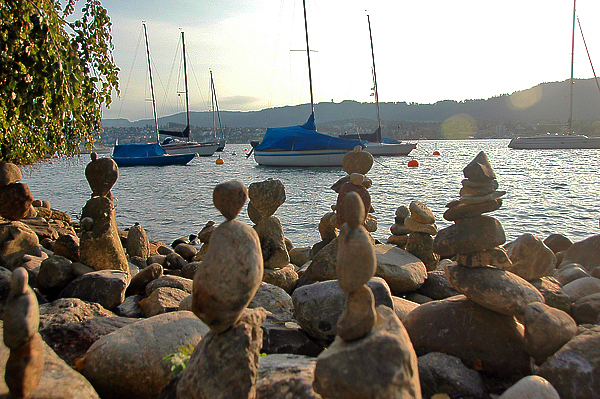
Krampf discusses the center of gravity (which my best friend Leslie kindly explained to me many times during college, when I repeatedly fell on the icy walks--I cannot say that I ever took her advice to lower my center of gravity by crouching down; instead I continued to tumble.) Krampf also provides photos of amazing rock-stacking feats (three of which I include here).
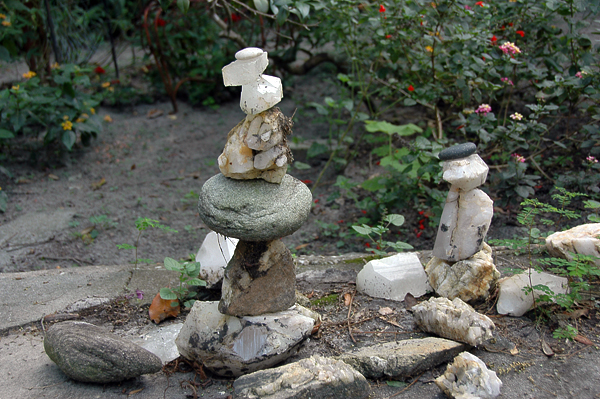
I could tell you that rock stacking is good training for writing, but really, what is it NOT good training for? So instead I will leave you just to enjoy these breath-taking photos, courtesy of The Happy Scientist.

If you have any rock-stacking stories, how you've done it yourself or if you've run across it somewhere unexpected, please share.
Thursday, October 27, 2011
Mark Doty at the Whiting Fdn Awards
Poet Mark Doty spoke to the honorees at the official announcement of the Whiting Foundation Awards last evening. Although we don't get to take home $50,000 dollars like the 10 members of the Whiting class of 2011 do, we can all still benefit from what Doty had to say to them, and to all writers.
Here are some excerpts:
A Nobel laureate has said, in a statement of praise for these prizes, “ The Whiting Awards are a wonderful antidote to self-doubt.” My immediate response is, well, good luck with that. If you’re at all like me, you’ll feel effervescent this evening, and lifted up by this experience for the next few days. In less than a week from tonight...your uncertainties and doubts in your own capabilities, in the worth of your projects, in the value of what we do – well, I wish that the Trustees of the Whiting Foundation had the power to simply wave those things away by giving you a citation and a check.
Or maybe I don’t wish that, not really. If there were not moments when it seems no one is paying the least bit of attention to what you do, or days when it seems the world absolutely does not need another lyric poem, another novel of ideas, I suspect our work would be far the less for it. Rejection must be at least as much a part of of our education as affirmation is...
And therefore artists, even ones who receive recognition, are subject to a particularly corrosive sort of bitterness. This is a mysterious thing, but I suspect it’s because the stakes involved here are primarily those of honor, of beautiful intangibles....The wanting is so large that it’s hard to figure out where satisfaction resides; what will it require, for us to believe we’ve done something worthwhile?
...But we artists -- and I will go even further out on this limb and suggest that particularly we writers – know what it is to want....Writers want to fit the world into words; we want to fit the world into our mouths. We seem to have an impossible longing for contact, impossible not only because of the boundaries of our separate skins but because of the fundamental inadequacy of the material we use for making connections: the ephemeral, airy, malleable stuff of language.
...Joy Williams has said it best.“Why does the writer write?” she asks. “The writer writes to serve -- hopelessly he writes in the hope that he might serve -- not himself and not others, but that great cold elemental grace that knows us.”
Doty (nearly) ends his speech with, "...may these awards be sustenance for you, and help you to negotiate with your doubt, and make good use of it."
And that's what we need to do, all of us writers: negotiate our doubt and make good use of it.
Halloween Idea: Poet!
Poets.org has some ideas on how to dress as your favorite writer for Halloween. For example, suppose you'd like to go as William Carlos Williams, here's what you'll need:
 You Will Need
A stethoscope
Medical gloves
Glasses
Brushed-back hair
Extra Credit

A bowl of plums

A red wheelbarrow full of candy
Visit the website for ideas on how to dress as Emily Dickenson, Edgar Allen Poe, Walt Whitman and Sappho as well.
You Will NeedA stethoscope
Medical gloves
Glasses
Brushed-back hair
Extra Credit
A bowl of plums
A red wheelbarrow full of candy
Visit the website for ideas on how to dress as Emily Dickenson, Edgar Allen Poe, Walt Whitman and Sappho as well.
Subscribe to:
Posts (Atom)